
Susana Restrepo Díaz. Socióloga con énfasis en filosofía, magíster en historia del arte y magíster en artes plásticas, electrónicas y del tiempo
The azulejaria in Belém do Pará, made up of small, colored glazed tiles and characterized by its subtle ubiquity in interior and exterior architecture, underscores its role as a material vehicle for the globalization of the Iberian culture. Through the expansion of tile art in the Brazilian Amazon, which influenced architectural practices in Belém do Pará, this text explores several historical pathways for transferring this knowledge and the iconographic universes that azulejos can embody. Their presence in civil architecture represents multiple historical periods in Brazil, from the Golden Age to the so-called Belle Époque, extending to the rubber cycle. This coexistence of periods in Belém do Pará will be discussed here under the notion of the Late Golden Age, even though contemporary urban renewals have compromised these tiled architectural ensembles.
Tiles in churches and palaces reveal signs of cultural exchange through their technical possibilities and serve as powerful symbols of conquest, tracing back to the Moors’ invasion of Portugal in the 13th century and the Portuguese´s invasion of Brazil in the 15th century, where the Empire found much of its imperial identity during the early modern period. This research will analyze the azulejaria[1] in the Amazonian epicenter of Belém do Pará as an artistic phenomenon that expresses the survival of the Iberian Union’s influence until the end of the 19th century. The expansion of this phenomenon also sheds light on the remnants of a form of naval intelligence, likewise shaped by fantasies that persist in the iconographic programs of architectural interiors.
The azulejaria, as a rhetorical impulse and social movement, was adapted to incorporate multiple styles through Mudéjar techniques.[2] Another technique known as májolica was quickly introduced from Italian centers to the Iberian Peninsula during the government of Manuel I. Májolica style illustrates its hybrid status as it traverses the realms of decorative art and painting, demonstrating significant multifaceted potential. This hybrid nature reflects iconographic meaning and cultural foundations rooted in the Iberian world, which became a crossroads for aesthetic traditions that later shaped artistic expressions in Peru, Mexico, Brazil, and India.[3]
In this sense, perhaps the study of the phenomena about the expansion of Portuguese tiles and the identity signs they carry cannot be confined to their manifestation in Belém do Pará; instead, it can be addressed in light of the intercultural relationships within the colonial period.[4] This approach can reveal complex commercial interactions regarding the exchange of techniques and iconographic patterns that tiles can embrace, so this analysis considers an example of the artistic projects in the administrative center. Lisboa frames the discoveries in the Brazilian paradise as the realization of a grand imperial dream, one example being the Palácio dos Condes de Óbidos where rich historical scenography illustrates the discovery of Brazil. There, Jorge Colaço’s work depicts the arrival of Pedro Álvares Cabral in 1500 to the lands of Vera Cruz. The image is a memory of this episode and, paradoxically, at the center of the frame kept the date of the year the First Republic of Brazil was proclaimed, 1889. Within the majólica technique[5] as a rhetorical art during the Renaissance, the geometries derived from Moorish culture transform into figures in perspective and landscapes, illuminating the scene with white and blue colors. Large ships of conquest in the distance, displaying Portuguese heraldry, reveal the arrival of the conquerors with their men and the red crosses of Christ on the frieze; the painting and ceramic practices merge here through the dissolution of both methods and viewpoints.
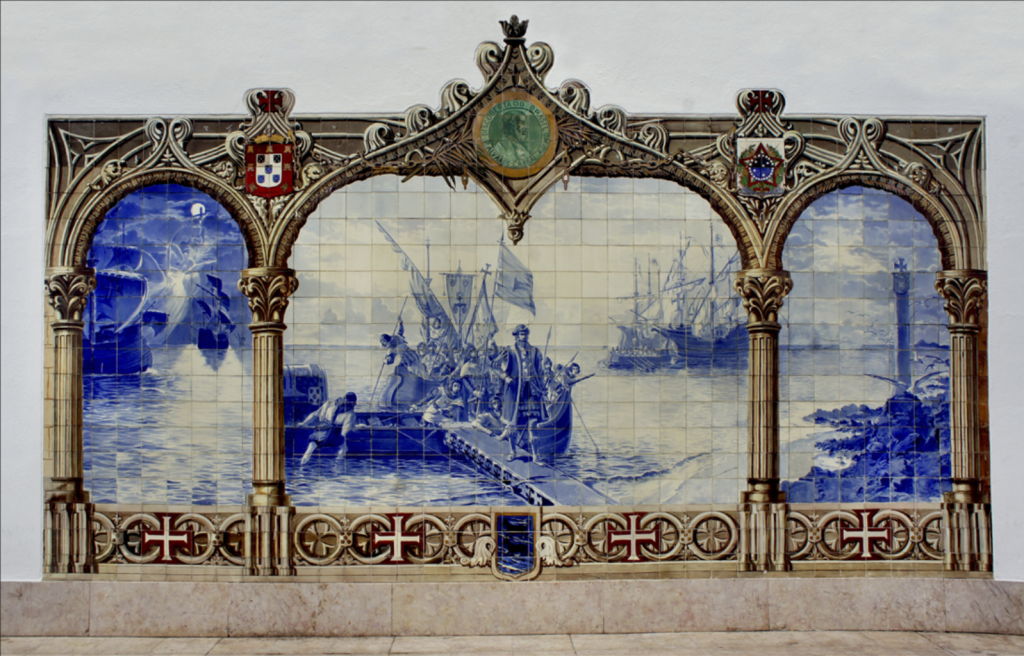
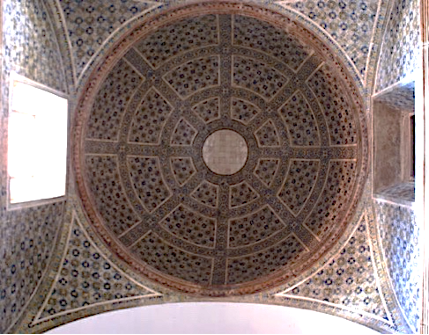
Through an archaeology of májolica tilework in Belém do Pará, we can reveal the influence of these iconographic programs which, from the perspective of the imperial project exalt the historical and commemorative genre of battles, conquests and a globalized Portugal, while they are primarily expressed through hagiographies of saints and devotional images in Brazil. This iconographic distinction is evident in the Convent and Church of San Antonio in Recife, Pernambuco, where the interior dome of the altar preserves the traditional Moorish pattern, while the walls of the building are covered with ornamental tile friezes and scenes narrating the life of San Francisco de Asís. Baroque tiles with hagiographic themes, dating from the late 17th to the mid-18th century, are present in the vestibule of the sacristy and, in some cases, in the main chapel of the Franciscan church in Belém. Similar examples appear across Brazil, particularly concentrated in Bahia. The ornamental frames define architectural spaces and become central elements within the iconographic program the azulejo encompasses.
Azulejaria serves as a crucial vehicle for introducing artistic styles and forms to create imaginary spaces within spaces. Rosário Carvalho explores how frames act as para-visual or para-textual elements, highlighting their importance in influencing observers’ perceptions of various contextual narratives. [7] The author particularly applies this approach to the Baroque linear frames from 1675 to 1725 in Lisbon, articulated with the Project Az Infinitum-Azulejo Reference and Indexation System. Her contribution enhances the understanding of the restoration of azulejos in structures like the Palácio Marquês de Fronteira and the Monastery of Graça, founded by the Augustinian Order.
This inquiry provides insights for understanding narrative forms and gaining a deeper comprehension of these azulejos, which, as Carvalho states, call for a dissolution between text and visual signs. The Iberian tiles act as a mirror in their local context too, where they are found in Belém a place that emphasizes the success of maritime traffic, trade, and navigation at their highest splendor. Thus, in the back of the Church of Saint Anthony, the sundial on the tower returns to the naval iconography that characterized the rise of one of the most significant Brazilian seaports interacting with the Amazonian waters. In this regard, the author Alcântara notes: “On the church’s bell tower, on its west-facing side, there is a clock face on a tile panel (12 x 12 pieces), already pointed out by Santos Simões, who managed to detect the date 1746 on it (…). The center of the circle dominating the composition is occupied by the sun, whose rays, shaped like leaves, extend into a geometric twelve-pointed star. The hours are marked in Roman numerals at their ends. In the spaces next to the corners of the panel, four figures that blow represent the winds from the cardinal points. They are framed by a shell, which is not yet the rocalha, although it already has its cut-out outline”. [8]
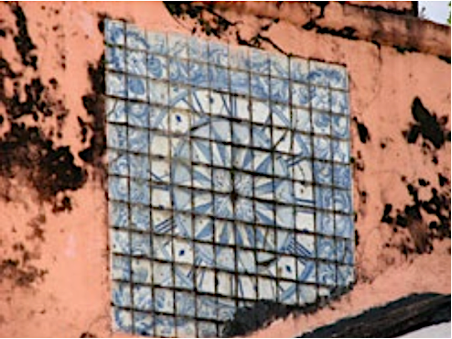
In that sense, the Mudéjar had a significant influence on the international Gothic movement when Manuel I sought to re-envision his empire, including Brazilian territories, with tiles that were appropriated and challenged by a predominant combination of craftsmanship and painting expertise. This blend transformed simple geometric motifs, typically found in the oriental treatment of malleable materials, into historic scenes and narratives celebrating the glory of the king and the presence of the Iberian crown. The transcultural phenomena underline that Iberian tiles provide us with intense signs, as literature about this art justifies, an ornamental grammar inherent to their nature. The technique, iconographic, and geographical boundaries that azulejaria can dissolve evince a strong phenomenon in the Iberian Union represented by the expansion of the tiles as part of a transcultural process that allows the multiplication of visual language, but furthermore its unique local manifestations. This brief paper focuses on the role of azulejaria in Belém do Pará to enhance a global culture under its own specificities and to illustrate the particular survival of the Iberian past, even among the industrial movement following the rebuilding of 1755 after the earthquake in Lisbon and the growth of the rubber cycle during the Belle Époque.
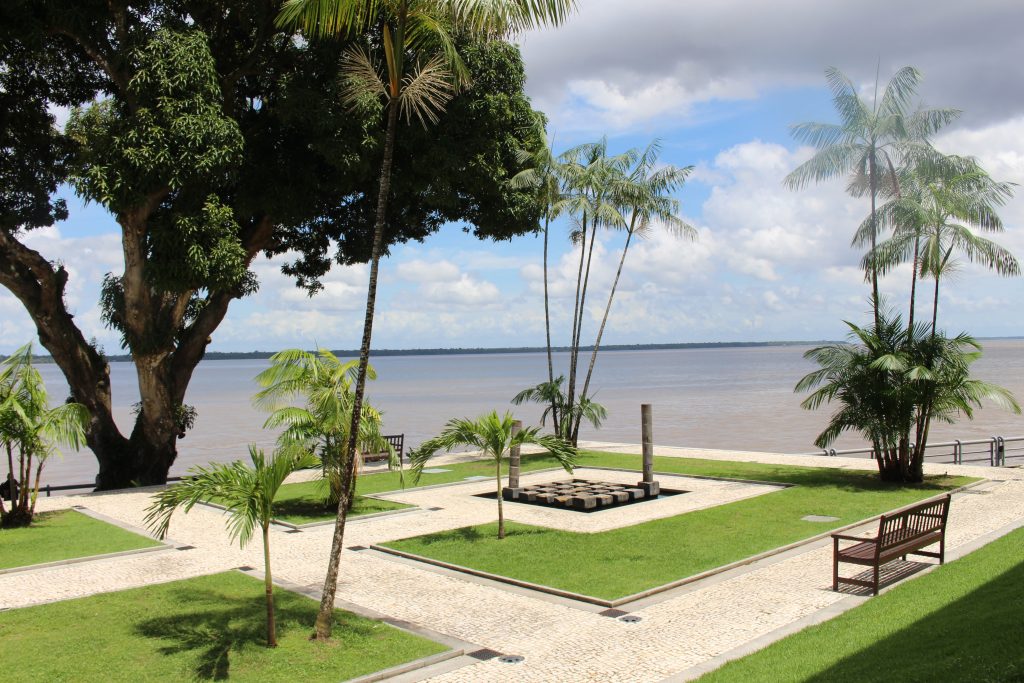
This text holds that the coexistence of the mudéjar technique, naval imagery in the iconic azulejaria of Belém and the prominence of flowers in the motifs represent a language of structural and ornamental elements in the architecture that reflects important transcultural specificities. Attention to a repertoire of symbols related to the navigation culture in Belém do Pará was awakened by the subtle presence of the Armillary Sphere at the entrance to Casa das Onzes Janelas, located in the Complejo Feliz Lusitânia. This iconic sphere became emblematic in the Portuguese empire with Manuel I as symbol of the triumph concerned to the art of seafaring; the emblem is located within this distinctive architecture, right next to the Forte de Presépio, the strategic nucleus where the city of Belém do Pará was founded, also the most well-known commercial point where the great sugar mills of the 18th century were established.
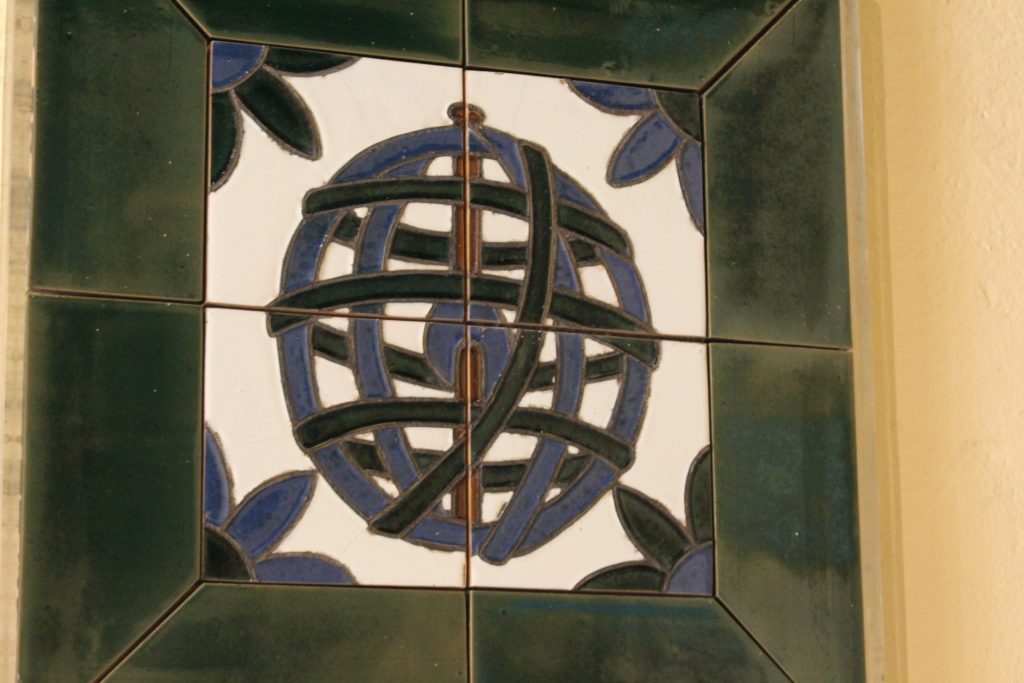
The omnipresence of the Armillary Sphere in Portugal is due to its emblematic incorporation under the crown of Don Manuel I in the 15th century, given the connection between the missions of discovery across the Atlantic and the power of this ancient instrument to read the winds and tides according to the apparent movement of the stars that this sphere symbolizes. Its usefulness during those trips enhanced both science and the economy of Portugal at that time. Under the globalizing impulse of the epoch, the king of Portugal ordered the extension of the Palace of Pena in Sintra between 1507 and 1520 and commissioned the Sevillian tile workshops to design the pattern of this sphere using the cuerda-seca technique with blue and green colors on a white tin background, bordered with black manganese.[10]
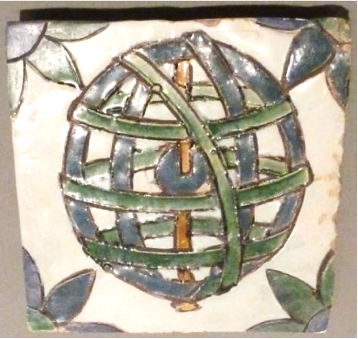
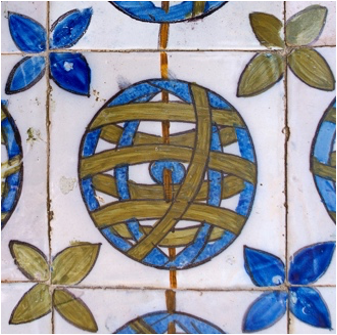
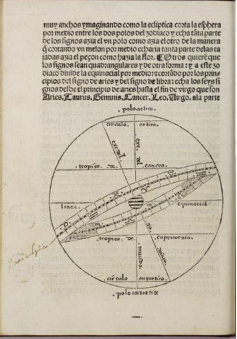
The Armillary Sphere features an angled ring that symbolizes the Sun’s path around the Earth—the ecliptic—marked by the twelve Zodiac signs. They follow the geocentric model, featuring multiple metal rings encircling a central sphere that symbolizes the Earth.[12] Crowning spaces of knowledge and a sign of erudition, this emblem anticipates the teaching of astronomy as a liberal art. Probably originating with Eratosthenes in the 3rd century BC, the sphere influenced Ptolemy’s Almagest and was later incorporated into Islamic astronomy by Ibrāhīm al-Fazārī.[13] Its wide expansion in the early colonial voyages has an advantage in the celestial navigation that the Portuguese empire ahead; however, it was Iberian culture that provided the crucial impetus for the transatlantic mission with Seville emerging as a key center for producing texts that expanded the cosmographic knowledge essential for navigation; all of those were part of the main responsibilities of the Casa de Contratación.[14]
Belém do Pará stands out for its role in the maritime missions launched from Portugal, owing to its strategic location and the presence of the Forte do Presépio, which served as its administrative center. This legacy has shaped a symbolic repertoire and iconographic program that reflects a sense of ubiquity grounded in its naval identity and maritime spirit. Alongside references to the millstone as a symbol of time and history, the tiles also feature another key maritime instrument: the wind rose. First depicted in Juan de la Cosa’s 1500 map, this emblem reemerges on the floor of the Institute of History and Geography of Pará, housed in the Solar do Barão de Guajará, constructed around 1837.
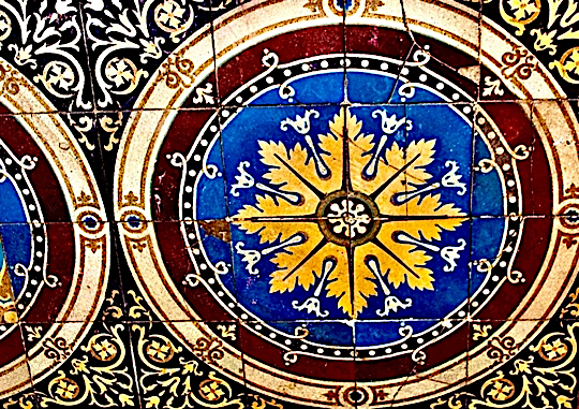
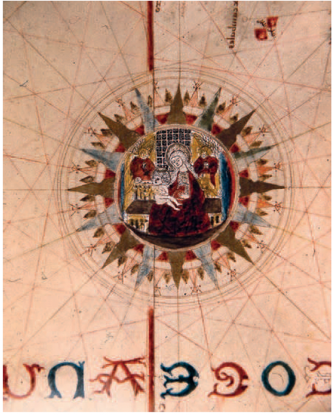
This architecture captures our attention through its layering of tiles that evoke multiple historical periods—from intricate interior details to a façade draped in a blue-and-white ceramic mantle. Situated within the Complex Feliz Lusitânia, the building encourages us to understand its architectural proposal not as an isolated monument but as part of an eclectic urban project where the Iberian tiles demonstrate the continuation of their techniques and functions within the context of structural, ornamental, and social status features. This urban project reflects a broader plan shaped by commercial networks, serving as a strategic enclave facilitating globalization and the transcultural processes that have defined Belém’s history.
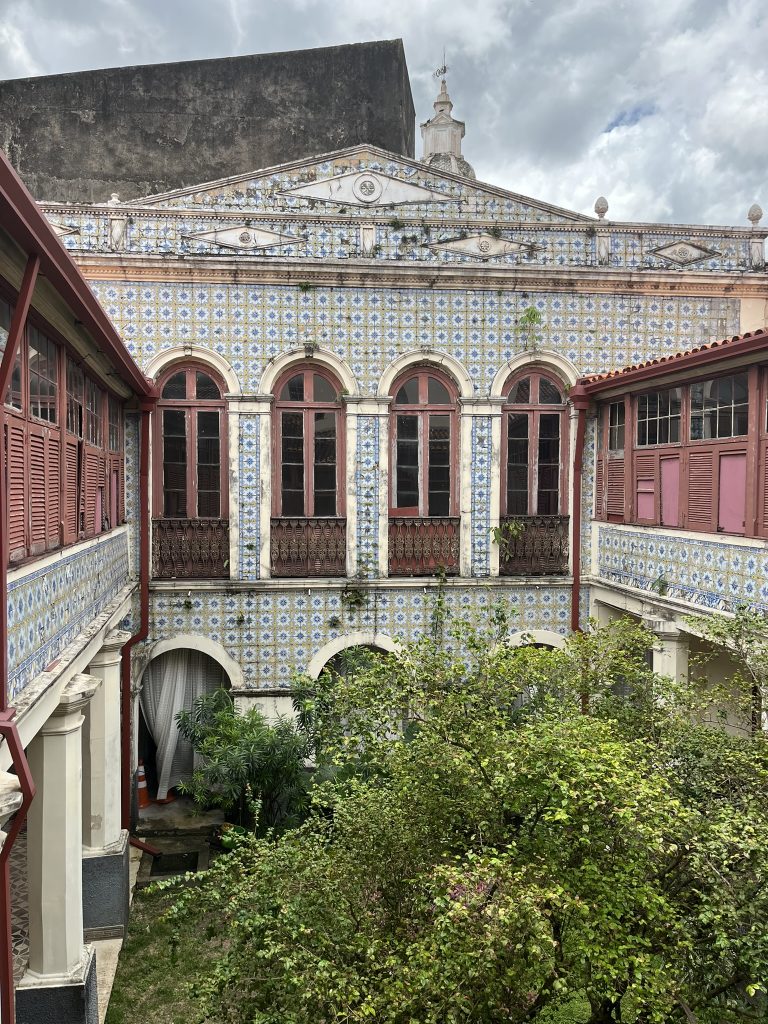

The façade of the Historical and Geographical Institute is embellished with semi-industrial tiles using the estampilha technique, featuring blue phytomorphic and geometric motifs on tin-glazed white ceramics on the outer side, while yellow tones wrap up the inner garden side. Both sets originate from Portugal, likely from the Viúva Lamego Constância factory or Lisbon’s Roseira factory on Calçada dos Cesteiros, known for cobalt-blue faïence and neoclassical square tiles with narrow frames, marking a new era in urban tile façades.[15] The Vale da Piedade factory manufactured tiles that imitate 15th to 16th century arista tiles originally created by the mudéjar community of Seville. Subsequently called Hispano-Moorish, these designs re-emerged during the Romantic movement of the 19th and early 20th centuries, alluding to medieval pavements and Islamic motifs. The early industrial production of tiles indicated this stylistic trend’s influence. [16] Floral and botanical motifs predominate in the designs of tiles with a strong hybridism with heraldic emblems and naval symbols, often appearing alongside stars from sundials, compass roses and armillary spheres.


Semi-industrial process on the architecture plan in Belém coexist with subtle fantasies in the Institute of Geography in Belém do Pará, together with the Guajará nymphs and murky waters that present to us the frame ship embraced by marine tentacles and monstrous creatures, as well as the surrounding mermaids. The Institute proudly dedicates one of its walls to the inspiring allegories of the ship, the sea monster, and the nymphs of Guajará, all of which beautifully represent the unique port identity of Belém do Pará. This tribute takes us back to the momentous events of April 14, 1823, when a brave resistance was organized under the leadership of José María de Moura. His courageous proclamation of independence to Emperor Pedro II came at a significant cost, leading to the loss of lives and imprisonment for many. Yet, once Belém embraced its independence in August of that same year, these heroic militants were honored with the emblem of the head of the Hydra of Lerna, intertwining classical mythology with their remarkable act of emancipation.
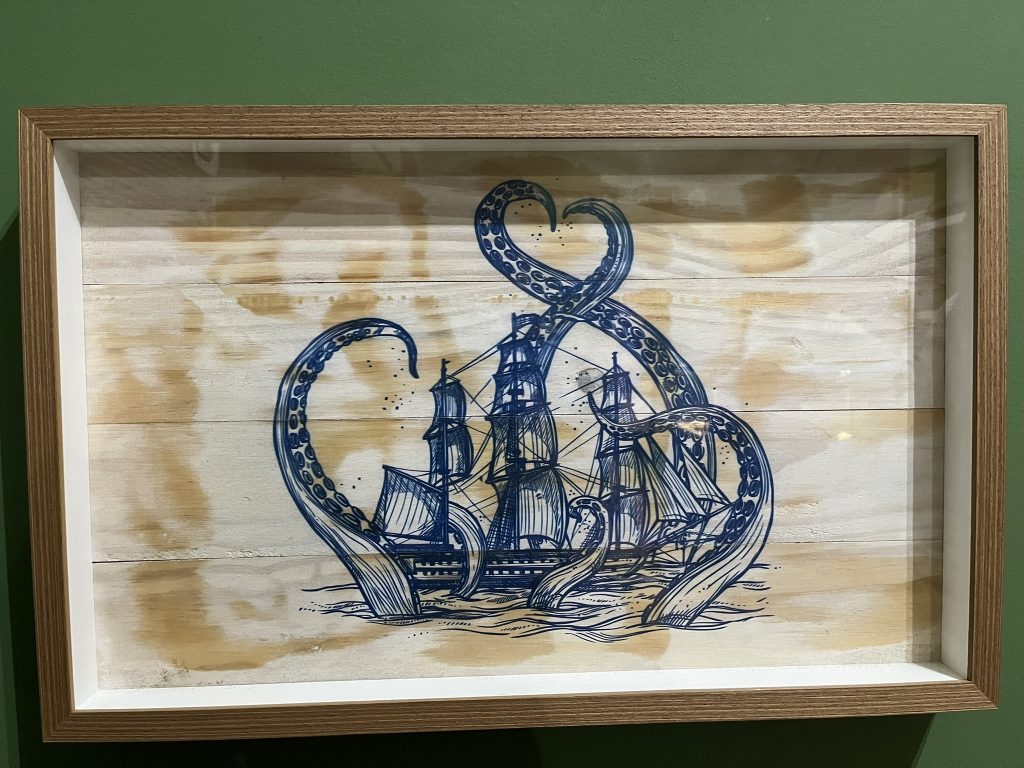
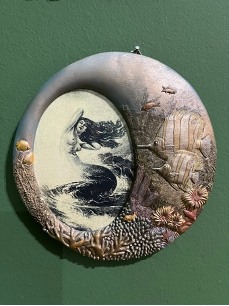
Other technical derivations of the tile, whether as antecedents or products of Iberian influence, strengthen iconographic programs that develop their iconotropy beyond the imperial identity underlying the reconstruction processes: classical hydras as allegories of independence, ships as symbols par excellence of Pará’s economy, and mermaids warning of the mystery of the untamed waters emerge through the use of the socarrat,[17] as expressed in the mosaic on the first floor of the Blue Palace, now known as the Belém Art Museum, beautifully showcases a unique shield that artfully blends flowers with arrows, sea monsters and staffs framed by stars. Each element lovingly echoes the compass rose that guides the course of the naval winds.


Designed by José Coelho da Gama e Abreu, the Baron of Marajó, the construction of this palace began in 1860 to serve as the City Hall. It was inaugurated before its full completion on August 15, 1883, although the final touches were finished in 1865. The construction, known as the consular style or retour of Egypt, which began in 1799, blends symbols from around the world in an eclectic manner, celebrating the memory of the Napoleonic campaigns and incorporating influences of Greco-Roman allegories with amphorae and the still-visible harpies, depicted as a pair of women with the bodies of birds, Aelo -stormy wind- and Ocípite -swift flight-. They were the daughters of Taumante and Electra, whose purpose was to drink from the love of the bodies of the dead. Both are portrayed as princesses with golden crowns and pearl necklaces, wielding the power of the breath of death through the smoke emanating from the amphorae. Its image merges with the imperial identity that endures with the spatial commitment of the French consulate of that era.[18]
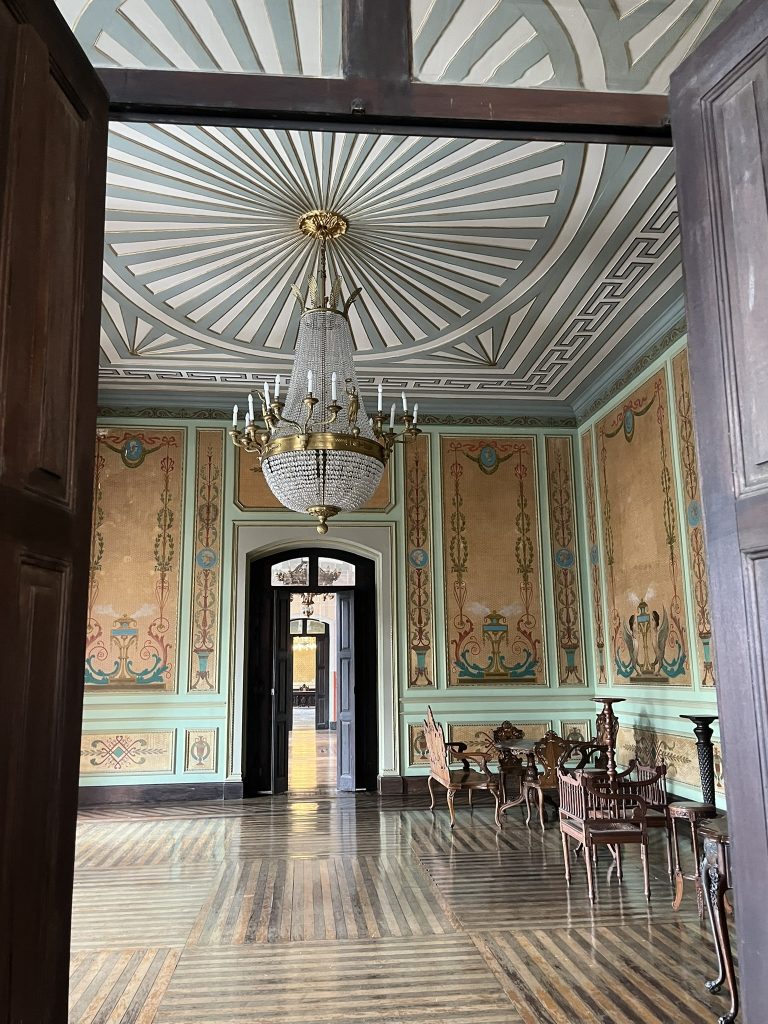

The urban project in Belém do Pará originated from a nucleus adjacent to Guajará Bay. It was expanded under governmental control in churches, convents and palaces, transforming its architectural landscape into a complex urban grid with a significant heritage policy. Until 1750, when Sebastião José de Carvalho e Melo, the Marquis of Pombal, became head of government as prime minister of José I, a policy aimed at enhancing the northern region of the Colony, which Belém governed, alongside the profits of the recently established Companhia Geral do Comércio do Grão-Pará e Maranhão. This context facilitated investment in its urban and architectural renovation under the guidance of the invited Genoese architect Antônio José Landi by the Marquis of Pombal. Landi introduced architectural elements from the Bolognese school in the first half of the 18th century. Thus, the Golden Age of Azulejos in the mid-17th and early 18th centuries drove a strong revival of azulejaria following the 1755 earthquake in Lisbon; this period of rebirth has been understood through the expansion of “azulejos pombalinos.”
Under this reconstruction initiative, the tile industry of Seville, once held in high regard for its strategic overseas expansion, developed a distinctive linguistic form referred to as Hispano-Muslim. This style is notable for its horror vacui, which produces a compelling enveloping optical effect. The abstract designs facilitated the repetition necessary for expedited assembly during reconstruction. The adaptability of placement on any façade evokes the complexity of a puzzle, which integrates seamlessly into the urban landscape, further enhanced by the glossy surface of the tiles and their prevalent application across a variety of buildings. This aesthetic embodies the splendor of tapestries from the Nasrid period, the final Muslim dynasty in the Iberian Peninsula (1238-1492).
Although most tiles in Belém do Pará are imported from Europe and undergo complex commercial dynamics that increase their price due to shipping costs, they are rapidly installed in the architectural and urban planning of the Amazonian city. This installation especially preserves their Mudejar influence, favoring Moorish patterns that innovate in phytomorphic designs, which were highly embraced by engineering practices and the latest catalogs of imported tile industries until the early 18th century.
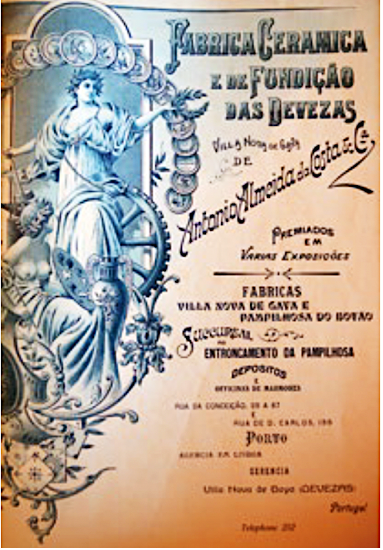
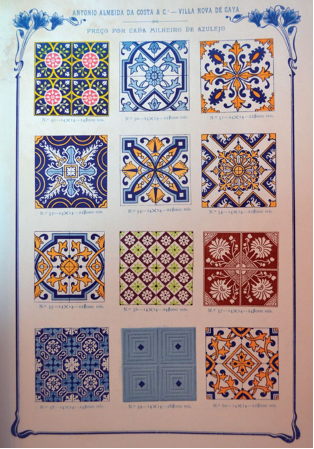
These catalogues still demonstrate the survival of many analogues with the Oriental tradition of tapestry and have the power to evolve buildings and civil houses, as well as blur the boundaries between techniques due to a certain instrumentalization of reverence and decoration in their application to urban and architectural projects in Belém. Once again, polymorphism predominates with flowers and arabesque foliage. During the expansion of tilework, we can observe the phenomenon of its internationalization and appropriation of the technique thanks to its semi-industrial properties, the material’s flexibility to adorn any architectural interior or exterior, as well as its thermal insulating virtues that balance the harsh maritime environment. However, this particular distinction was also valuable for a growing elite that derived its prosperity from the rubber cycle.
Among the civil architecture that proliferated in Belém do Pará during this period, this essay highlights the Guaraná factory and the Palacete Pinho. The Guaraná factory, signed by Hilário Ferreira & Cia. Ltda, is an 18th-century building, although some sources claim it was once a Jesuit convent. From Rua Siqueira Mendes, the building features two floors, and what catches our attention is the connection at the back that provides access to Guajará Bay; underground there are tunnels connected to the Carmo Church and St. Alexander’s Church. This connection could express the commercial interactions in which the Church plays a key role, influencing the economy in Belém.


In this context, azulejaria represents not only economic growth but also social mobility aspirations. Although the building was initially designed for commercial use—associated with Guaraná, one of Brazil’s iconic products—it did not always function as such. The factory’s brand identity was later introduced, highlighted by a sculpted half-relief frame on the façade. Nonetheless, from the outset, the architecture stood out with its remarkable tile cladding, which served an ornamental purpose by featuring a wind rose motif surrounded by floral and phytomorphic patterns. Rendered in cobalt blue against a white backdrop, these elements demonstrate both technical sophistication and the lasting impact of the Pombaline aesthetic tradition.


Detail of the Phatrons of Tiles from the former Guaraná Soberano Factory. Rua Siqueira Mendes, 144. Source: Coleção Lacore/UFPA, pictures from Thais Sanjad (2015)
Schematic and repeated patterns continue to influence the architectural projects in Belém strongly. Even at the beginning of the nineteenth century during the Industrial Revolution, the remarkable rubber cycle led to the rise of specialized tile companies and significant naval movements to secure the import of designs and innovative building methods. For example, the Santo Antônio Vila Nova de Gaia factory received designs from England, France, Belgium and Switzerland. Similarly, the Bica do Sapato and Viúva Lamego factories in Lisbon incorporated patterns from Portugal, Germany, Holland and France; under the same global reception of innovations from German designs by Villeroy & Boch. All these European factories enriched the creation of motifs primarily based on the Mudejár technique, known for its floral spirals, geometries, arabesque shapes and systematic frames. Moreover, the innovations of this century reflect new styles of tile application for creating panels both outside and inside civil houses and the elite’s palaces. Additionally, the innovations of this century showcase new tile application styles for creating panels inside and outside residential buildings and elite palaces. These innovations are making significant contributions to architectural decisions, despite the considerable risks involved, especially considering all the demolished structures to this day.

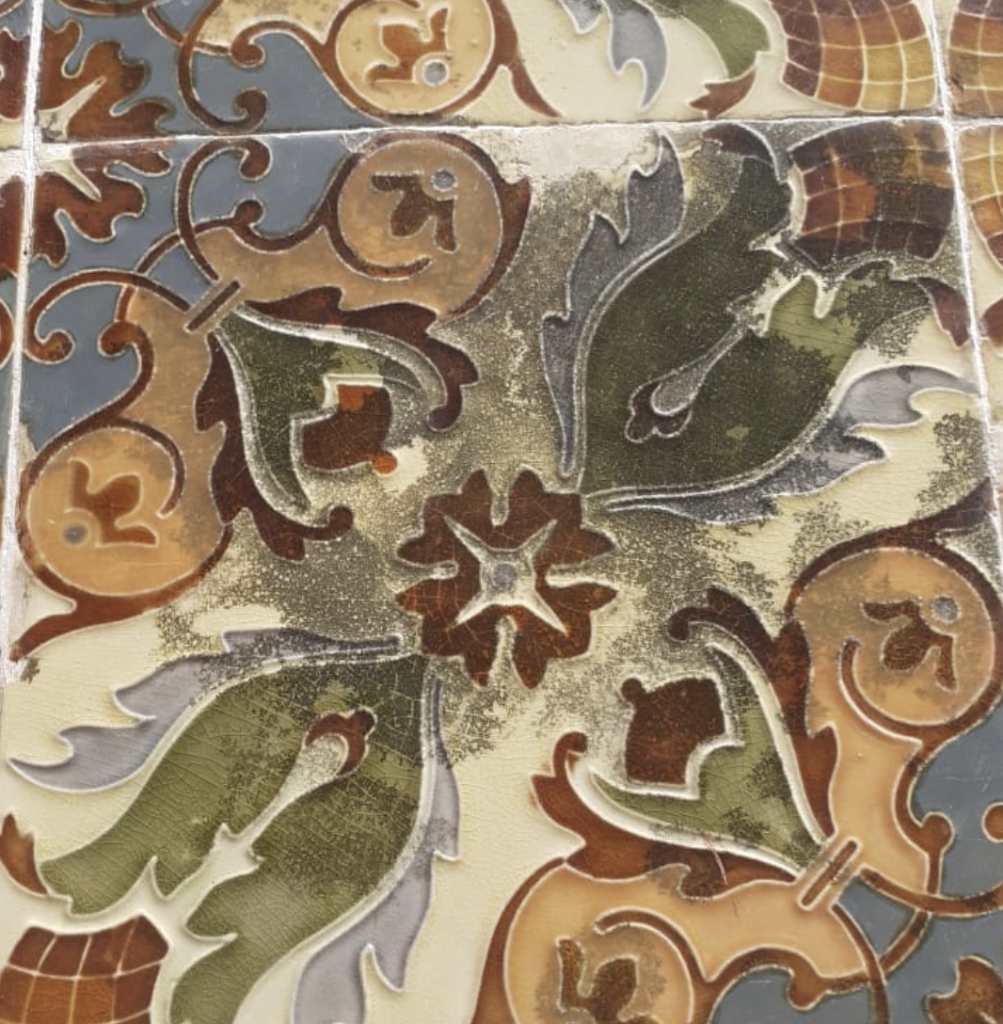
The outside of the house, made of German tiles painted with translucent glaze and recognized as an icon of modern architecture by the National Institute of Historical and Artistic Heritage of Belém (Iphan), was built in 1897 during the rubber boom. Commissioned by the merchant and politician Antonio José Pinho, it features a façade adorned with tiles manufactured by Villeroy & Boch Mosaik in Mettlach, Germany. Each tile displays a half-relief glazed ceramic pattern, a composition of isometries involving axial symmetry achieved through repetition and translation. The tiles serve as ornaments that can be interpreted mathematically and persist in the concept of totality, where the piece is initially subordinate to the overall structure and, later, to the urban plan of the time, but soon regains its individuality as a unitary identifying element essential for its valorization and preservation within a heritage restoration project.
On the other hand, unlike the symmetry defining the múdejar style and the persistent Moorish motifs and patterns adorning the exterior, the Palace of Bologna shines eclectically, starting with a façade that showcases floral relief on the shaft. The engineer Francisco Bologna, welcomed by Antonio Lemos, gifted this building to his wife, Alice Tem-Brink, during the rubber cycle. This eclecticism is evident in the palace’s refined details and the blend of construction materials that reflects the regional craftsmanship, according to the museography defining it today. It is crucial to remember that Francisco Bologna was pivotal in establishing the city’s Engineering School. Furthermore, it illustrates the close connection between the elites who led engineering, design, and architecture and the political elites who governed Pará then. The rise of tile heritage responded to this close relationship, primarily driven by the economic expansion based on rubber exploitation and the discourses of innovation and civilization at the beginning of the century.
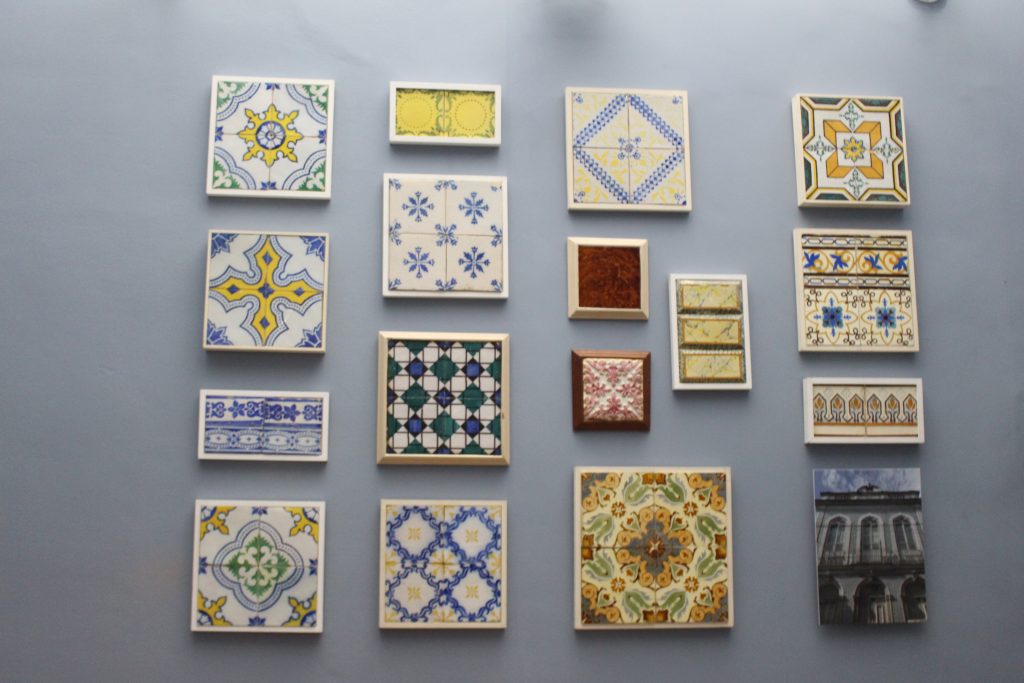
Azulejo holds its own ambivalence in the medium as a paradox that results, at the same time, in its principal virtue; the transcultural process through the expansion and active role of the factories still shines on the surface of the architecture, emphasizing a decorative use with dynamism, optical interplay, and an organic color palette, allowing for an integral experience of the city. This approach could be understood in terms of Sarges, author of La Belle-Époque in Amazonia in the rubber era: “By 1902, the city of Belém had already been called Paris n’América or Petit Paris and the intendant’s project was expanding with the construction of several palaces, a stock exchange, large theatres, churches, a morgue, large squares with lakes and fountains, sanitary infrastructure, the widening and paving of roads, the construction of a sewage system in the central area, the embankment and drainage of rivers and streams, the planting of hundreds of mango tree saplings in the avenues and boulevards”.[20]
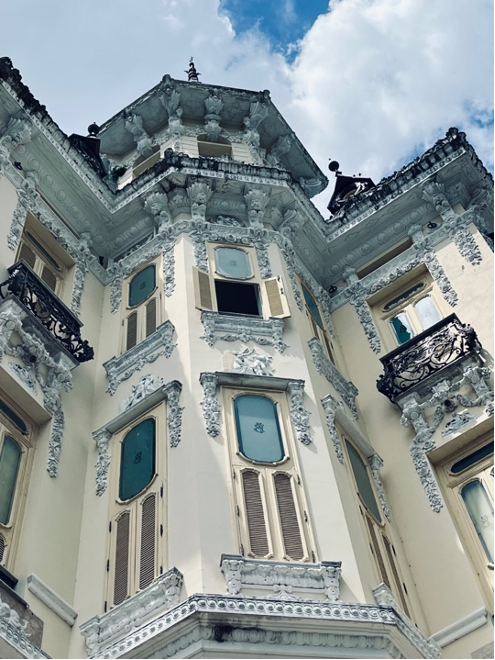
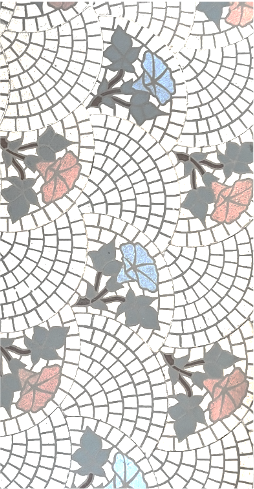
The Oriental inflexion overlaid the Christian motif that protagonizes the architectural heritage in the Belle Époque in Belém do Pará. Ceramic panels, resembling carpets cover the interiors with details and variety, framed by borders featuring new patterns that attempt to evoke a classical thought; this search in the organic and integral notion of the city was born out of a style known as eclecticism. As the author Céline Ventura Teixeira expressed, “azulejo would come to be an object reflecting not only a range of trends in an increasingly connected world but also cultural encounters and aesthetic miscegenation. At the crossroads of diverse skills, the azulejo shows a trans-aesthetic dimension through its fusion of ornament and iconography.”[21] Nevertheless, she emphasized the confluences and hybridization processes that arise from the polymorphic nature of tiles.
The nature of Iberian tiles acts as a vehicle for transculturation, responding in the 19th century to an urban plan that allowed the survival of the complexity of the iconographic programs for a societal spirit searching for a new economic model based on the rubber cycle and engineering academies innovating in construction models. Now, the splendor of azulejo is understood through the lens of heritage and historical value, but here also lies the possibility of azulejos holding their late Golden Age in a sense where the multiple pasts and proliferation from the details never vanished in any architectural manifestations in Belém do Pará.
References
Alcântara, Dora Monteiro e Silva . “El azulejo em Brasil. Siglos XVII al XIX”. In: Formación Profesional y Artes Decorativas en Andalucia y América. Sevilla: Junta de Andalucia, Consejeria de Cultura y Médio Ambiente, 1991.
Alcântara, Dora Monteiro e Silva de; Soares de Brito, Stella Regina e Bastos Caminha Sanjad, Thais Alessandra. Azulejaria em Belém do Pará: inventario -arquitectura civil y religiosa -século XVII ao XX. Brasília: Iphan, 2016.
Bellia, Laura, Viviana del Naja and Francesca Fragliasso. “Optical Characteristics of Traditional Portuguese Azulejos: Mixing Colors to Obtain ‘Cool’ Building Façades.” Journal of Daylighting 7, no. 2 (2020): 273–81.
Carvalho, Rosário Salema. “The Iconographic Role of Azulejo Frames.” Word & Image (London. 1985) 36, no. 2 (2020)
Carvalho Nunes, Mateus, and Elna Maria Andersen Trindade. “Janelas e Portas Da Residência e Administração Dos Governadores Do Grão-Pará: O Movimento das Imagens em Antônio José Landi.” Art is on (Lisboa) 9, no. 9 (2019): 26–43.
Coentro, S, V Muralha, A Lima, A Pais, A Silva, and J Mimoso. “The Colors and Techniques of 17th Century Portuguese Azulejos: A Multi-Analytical Study.” Microscopy and Microanalysis 17, no.2 (2011): 1782–83.
Cruz, Ernesto. Casas e palácio do governo: residências dos capitães-mores, governadores e capitães-generais e presidentes da província do Pará 1616-1974. Belém: Governo do Estado, 1976.
Collado Ruiz, Josefa. Cenefas de los azulejos portugueses durante los siglos XVI, XVII y XVIII. Universidad Complutense de Madrid, Trabajo de licenciatura no publicado, s.f.
Da Silva Aguiar, Inês. “Reframing: Cataloguing Patterned Azulejos Frames.” Art Is on (Lisboa) 2, no. 2 (2022): 24–32.
Derenji, Jussara da Silveira. “Arquitetura eclética no Pará – no período correspondente ao ciclo econômico da borracha: 1870-1912”. In: Ecletismo na arquitetura brasileira, edited by Annateresa Fabris. São Paulo: Nobel/Edusp, 1987.
Gruzinski, Serge. Las cuatro partes del mundo : historia de una mundialización. Ciudad de México: Fondo de Cultura Económica, 2016.
Lins, André Gustavo da Silva Bezerra. Representações de indentidades da Cidada Necessária (modelos e configuraçoes urbanas distintas) na iconografía Recife colonial: planos de Pherman-quo do ante-bellum á restauração. Universidade de São Paulo, 2011.
Lima, Zelinda Machado de Castro e (org.). Inventário do patrimônio azulejar do Maranhão. São Luís: Ed. AML, 2012.
Mangucci, Celso. “Os Arquitectos e a Direcção Das Campanhas Decorativas Com Azulejos.” Art Is on (Lisboa) 6, no. 6 (2018): 25–31.
Aguiar Aguilar, Maravillas. “Los Primeros Instrumentos de Navegación que Viajaron a América: Un Estudio Del Quatri Partitu o Espejo de Navegantes (ca. 1528) de Alonso de Chaves.” Mélanges de La Casa de Velázquez, no. 49 (2019): 223–44.
Mimoso, João Manuel. “Early Façade Azulejo Frames by Fábrica Roseira of Lisbon.” Art is on (Lisboa) 2, no. 2 (2022): 54–60.
Nieto Olarte, Mauricio. Exploration, religion, and empire in the sixteenth-century Ibero-Atlantic World: A new perspective on the history of modern science. Amsterdam: Amsterdam University Press, 2022.
Sadighian, David Bijan. “The Business of Beaux-Arts: Architecture, Racial Capitalism, and Branqueamento in Belle Époque Brazil” Architectural Histories 13, no. 1 (2023).
Tocantins, Leandro. “Antonio José Landi (1708-1791), o arquiteto régio do Grão-Pará”. Revista do Instituto Histórico e Geográfico Brasileiro. Rio de Janeiro, nº 348 (1985): 221-234.
Ventura Teixeira, Céline. “A Palimpsest of Ornaments: The Art of Azulejo as a Hybrid Language”. Renaissance Studies 34, no. 4 (2020): 593–623.
[1] The word comes from the etymological Arabic term zuleij, whichrefers to smoothly polished objects. Céline Ventura Teixeira. “A Palimpsest of Ornaments: The Art of Azulejo as a Hybrid Language.” Renaissance Studies 34 (2020): 593.
[2] The cuerda seca technique creates shallow lines on the tile with chemicals, which are colored with manganese, and different glazes are poured into the spaces. This method is used on flat tiles to form a mosaic-like design without cutting small pieces. The arista technique employs a mould with a carved design. Soft clay pressed into the mould retains raised lines, acting as barriers that separate glaze colors and keeping the colors from mixing. Josefa Collado Ruiz. Cenefas de los azulejos portugueses durante los siglos XVI, XVII y XVIII. (Universidad Complutense de Madrid, trabajo de licenciatura no publicado, s.f.): 23-24
[3] Céline Ventura Teixeira. “A Palimpsest of Ornaments: The Art of Azulejo as a Hybrid Language.” Renaissance Studies 34 (2020): 594.
[4] Serge Gruzinski. Las cuatro partes del mundo: historia de una mundialización. Fondo de Cultura Económica, 2016.
[5] This involves painting coloring oxides onto a raw tin glaze with a brush, as if it were a canvas, using the entire surface of the glazed piece or a set of tiles. Collado Ruiz, Cenefas de los azulejos portugueses durante los siglos XVI, XVII y XVIII, 25.
[6] https://redeazulejo.letras.ulisboa.pt/pesquisa-az/ficha.aspx?ns=211000&id=4972&lang=PO&IPR=4748
[7] Rosário Salema Carvalho. “The Iconographic Role of Azulejo Frames.” Word & Image 36, no. 2 (2020): 138
[8] Dora Monteiro e Silva de Alcântara, et al., Azulejaria em Belém do Pará: inventario -arquitectura civil y religiosa -século XVII ao XX- (Iphan, 2016), 99.
[9] Percival Tirapeli. Igrejas Barrocas do Brasil. São Paulo, Metalivros, 2008.
http://acervodigital.unesp.br/handle/123456789/65845
[10] Collado Ruiz. Cenefas de los azulejos portugueses durante los siglos XVI, XVII y XVIII, 56.
[11] https://archive.org/details/tratadodelespher00fale/page/n31/mode/2up
[12] Maravillas Aguiar Aguilar, “Los Primeros Instrumentos de Navegación que Viajaron a América: Un Estudio Del Quatri Partitu o Espejo de Navegantes (ca. 1528) de Alonso de Chaves.” (Mélanges de La Casa de Velázquez, 2019): 225.
[13] Azucena Hernández Pérez, Esfera armilar. Base de datos digital de Iconografía Medieval. (Universidad Complutense de Madrid, 2018), www.ucm.es/bdiconografiamedieval/esfera-armilar
[14] Nieto identifies, for example, the following cosmographical writings at the service of navigation circulating from Sevilla: Martín Fernández de Enciso with Suma de Geographia (1519, 1546); Alonso de Chaves with Quatri partitu en Cosmographia pratica, also known as the Espejo de navegantes (1518, 1538); Francisco Faleiro with Tratado del esphera y del arte de marear: con el regimien to de las alturas: con algunas reglas nueuamente escritas muy necessarias (Vallaloid, 1545); Johannes de Sacrobusto with Tratado de la Sphera (translation by Jerónimo Chaves in Sevilla, 1545); Jerónimo Chaves with Repertorio de los Tiempos (1548); Martín Cortés with his Breve Compendio de la esfera y el arte de navegar (1551); Pedro de Medina with Regimiento de Navegación (1563); Juan de Escalante de Mendoza with his Itinerario de navegación de los mares y las tierras Occidentales (1575); Rodrigo Zamorano with his Compendio del arte de navegar (1581); Diego García de Palacio with Instrucción naútica (México, 1587); Baltasar Vellerino de Villalobos with Luz de navegantes (Manuscript, 1592) and Andrés García de Céspedes with Regimiento de Navegación (Madrid, 1606). Mauricio Nieto Olarte, Exploration, religion, and empire in the sixteenth-century Ibero-Atlantic World: A new perspective on the history of modern science. (Amsterdam University Press, 2022), 81.
[15]João Manuel Mimoso. “Early Façade Azulejo Frames by Fábrica Roseira of Lisbon.” Art is on (Lisboa) 2 (2022): 56.
[16]After the name of Solar do Barão de Guajará, a distinguished politician from Vigia and the founder of the Academia Paraense de Letras in 1900, where he also held the position of the inaugural president of the Institute. The residence has undergone several transfers of ownership. Following his departure in 1912, the property was acquired by Belém’s mayor, Abelardo Condurú, in 1942, inclusive of all its contents. Dora Monteiro e Silva de Alcântara, et al., Azulejaria em Belém do Pará: inventario -arquitectura civil y religiosa -século XVII ao XX- (Iphan, 2016), 56.
[17] Unglazed terracotta ceramic.
[18] During the early modern period, Plantin’s workshop produced images inspired by fantasies and animals During the early modern period, Plantin’s workshop produced images inspired by fantasies and creatures such as dragons and other fantastical beings. Grotesque engravings sold by street vendors and merchants also provided essential motifs. Phillippe Morel. in la figure de l´imaginaire dans la peinture italienne de la fin de la Renaissance (Flammarion, 1997),cited in Ventura Teixeira. “A Palimpsest of Ornaments: The Art of Azulejo as a Hybrid Language”, 600.
[19] Among others, the inventory that Alcântara, Soares de Brito and Thais Sanjad remember the catalogue of the Cerâmica do Carvalhinho factory; catalogue of the Alemã Glasierte Steingut-Wandplatten factory; catalogue of the De Louça de Sacavém factory, Francesa Revêtements Ceramiques de la Faiencerie and Choisy-Le-Roi. Those catalogues are cited in: Silva de Alcântara, et al., Azulejaria em Belém do Pará: inventario -arquitectura civil y religiosa -século XVII ao XX-, 56.
[20] María de Nazaré Sarges. La Belle-Époque en la Amazonia en la época del caucho. In: José Manuel
Santos Pérez and Pere Petit. La Amazonia Brasileña en Perspectiva Histórica (Aquilafuente, 2006), 91-107. Cited in Aldrin Moura de Figueiredo. “Amazônica Chimera: Art, Mecenate and Collecting in Belém Do Pará, 1890-1910.” Revista de Pesquisa Histórica 1, (2010): 3.
[21] Ventura Teixeira. “A Palimpsest of Ornaments: The Art of Azulejo as a Hybrid Language”, 615.