
Cathryn Jijón, PhD Candidate, Art History, The Graduate Center, CUNY
Entering the second-floor gallery of the Museu de Arte de Belém (MABE) during our museum walkthrough with historian Aldrin Moura de Figueiredo, I found myself struck by Theodoro Braga’s monumental A fundação da cidade de Nossa Senhora de Belém do Pará (The Foundation of the City of Our Lady of Belém of Pará) (1908) (fig. 1).
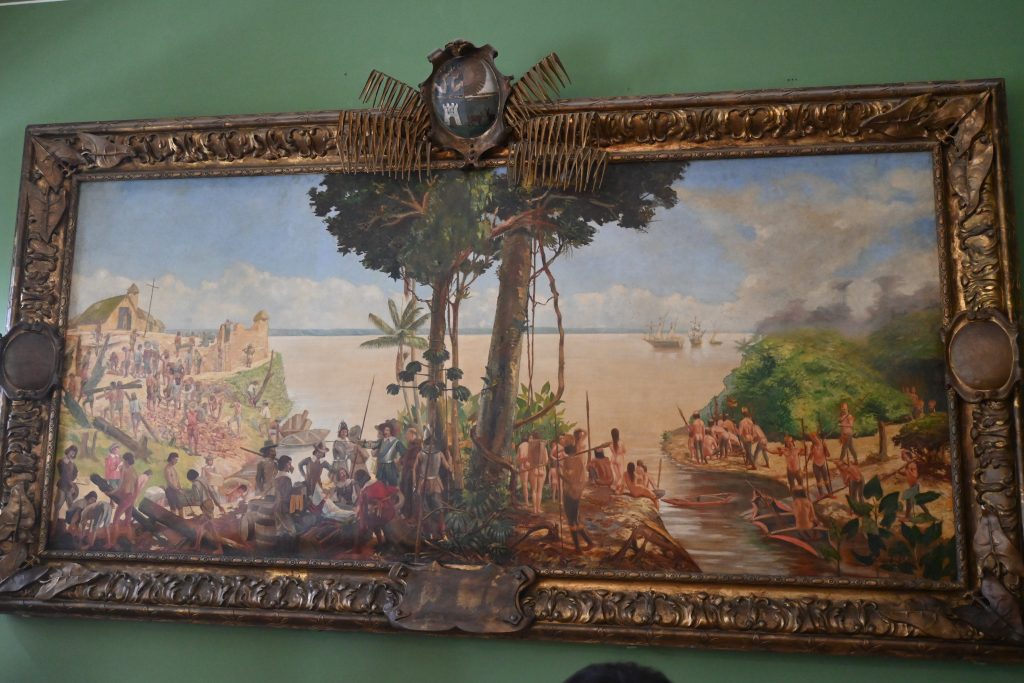
Braga’s panoramic history painting portrays the founding of the colonial city of Belém on January 12, 1616. The dipartite composition, read from right to left, depicts the Indigenous Tupinambá people observing the arrival of Portuguese ships in the bay and, moving forward in time, the construction of the colonial military fort, the Forte do Castelo. At center and dividing the composition are two tall trees that extend upwards and disappear beyond the painting’s frame. Below the trees, at right, appear Indigenous figures, largely depicted from the back and in the nude, while at left, their mirror position is occupied by the painting’s “hero,” Portuguese conquistador Francisco Caldeira Castelo Branco, and his general staff. The work’s elaborate frame also interacts directly with the scene— intricately decorated, it features three-dimensional tropical flora that echo the painting’s landscape details.
As Moura de Figueiredo explained during our walkthrough and has detailed in his extensive scholarship on Braga, the painting transforms this historical event into a nationalist mythology, whereby the city’s founding becomes an origin story for the Brazilian Amazon at large. Writes Moura de Figueiredo:
Como uma espécie de episódio embrionário, o retrato da fundação de Belém era, por si só e por isso mesmo, um mito fundador da identidade nacional na Amazônia. A escolha do tema possuía, em vista de seu significado histórico, muito evidente: o nascimento da capital do Pará legitimava a imagem do luso conquistador e criadora dessa Feliz Lusitânia, como resultado desse encontro de dois povos diferentes. Como fruto de uma criação divina, por mãos humanas—paradisíaca portanto—a cidade deveria nascer com características marcadas por valores cristãos, humanos, civilizados e heroicos. Na mão do pintor, os documentos são lidos, transcritos, e, por vezes omitidos, para justificar o argumento da obra.[1]
As such, Braga’s painting occupies an interesting space within the cultural and political history of Belém. Politician and city mayor Antônio Lemos commissioned the painting during the height of the rubber boom (1879-1912), a period that saw an influx of capital and increased cultural patronage in Belém and which wrought devastating violence against Indigenous and non-Indigenous Amazonians, laborers, and the land itself at the hands of rubber barons.
The relationship between Braga’s painting and the rubber boom is something that I find particularly interesting. Moura de Figueiredo notes that Braga, despite conducting in-depth archival research to ensure the historical veracity of the painting, chose to include historically inaccurate elements that responded directly to rubber boom politics. In the painting, the fort appears as a complex stone structure, rather than a simple wooden building, while Caldeira and his men appear empowered and finely dressed, rather than destitute and seeking help. These strategic changes obscure the inherent precarity and uncertainty of the early-colonial Portuguese settlement, instead idealizing Belém’s founding. In doing so, Braga’s painting suggests that Belém’s rubber-driven ascendance at the turn of the twentieth century was a natural outcome of the city’s long and triumphant historical trajectory. As Moura de Figueiredo writes, “A grande capital da borracha não poderia, no entanto, aos olhos do pintor e principalmente de seu mecenas—o intendente Antonio Lemos—, ter experimentado uma origem tão simplória. O presente reinventou o passado na paleta do pintor.”[1]
In thinking more about Braga’s A fundação da cidade de Nossa Senhora de Belém do Pará, I found myself wondering about how, in addition to reflecting the immediate political interests of Belém’s ruling class, the painting responds to or enacts an extractivist gaze. Igor Gonçalves Chaves, in his analysis of Braga’s painting, identifies the trees at center as “grandes embaúbas e seringeuiras,” or cecropia and rubber trees (fig. 2).[1] Given their prominent position at the center of the painting, it’s difficult for me to believe that Braga’s towering rubber trees are purely picturesque. The rubber tree is, after all, the landscape element around which the entire historical narrative hinges, and they also mark the passage from the Indigenous “past” to the beginnings of Western “civilization” in Paraná-Guaçu (now Guajará Bay), thus smoothing over histories of colonial violence and Tupinambá resistance against the Portuguese.
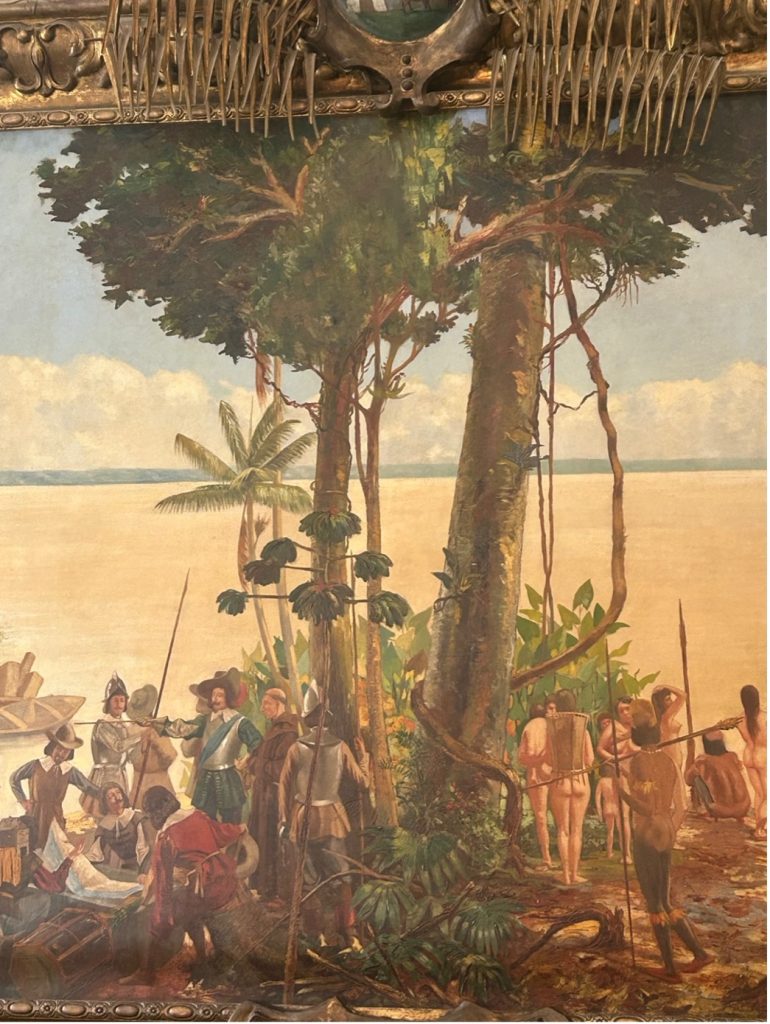
To me, this placement underscores the symbolic function of the rubber tree, evoking notions of progress, development, and westernization. As such, it suggests the promise of what historian José Murilo da Carvalho identifies as Brazil’s grandeza, or greatness, and the belief that harnessing and developing its rich resources will allow the country to “become a powerful empire.”[1] Elaborating Murilo da Carvalho’s argument, environmental humanities scholar Jessica Carey-Webb specifically links the promise of Brazil’s grandeza to the rubber boom, noting that the Amazon became a contested space during this period precisely because of its “potential riches” and the promises it held for the country’s future.[2] Marking the transition to the beginning of colonial empire, Braga’s rubber tree inscribes the extractive ideals of the rubber boom into the city’s historical past and founding mythos. That Braga’s Tupinambá figures become docile, productive laborers working to construct Belém’s fort also implies the desired labor relations of the period, during which rubber barons exploited and enslaved Indigenous populations throughout the Amazon.
An exploration of the extractive gaze is something that shapes my own academic research. I found myself drawn to Braga’s painting, in part, because of the way that it intersects with my study on Oswaldo Guayasamín’s mural El Descubrimiento del Río Amazonas (The Discovery of the Amazon River) (fig. 3).[1] The three-part mural depicts Francisco de Orellana’s sixteenth century expedition that led to the first European encounter with the Amazon River, and my analysis situates Guayasamín’s treatment of the river in relationship to contemporaneous discourses that linked control of the waterway to notions of progress and the promise of Ecuadorian economic modernization. Though completed in Quito, Ecuador in 1960, more than fifty years after Braga’s painting debuted in Belém’s Teatro de Paz, Guayasamín’s mural similarly recasts early colonial history through the extractive desires and nationalist ambitions of the twentieth century.
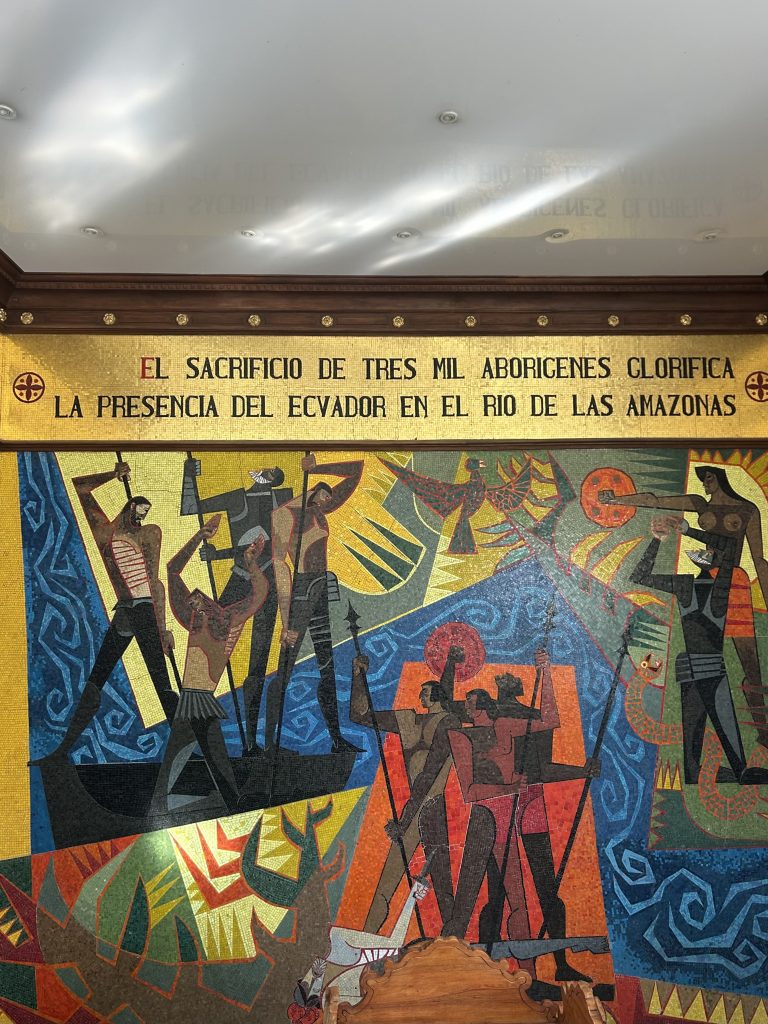
Much is, of course, also different about these works, including the artists’ positionalities with respect to the Amazon, the historical moment in which the paintings were completed, the geographies pictured, and the artists’ material and stylistic choices. Despite these differences, having the opportunity to see Braga’s monumental painting in person and learn more about the history of Pará through MABE’s collection brought many productive tensions and intersections to the surface, underscoring the value of transnational perspectives in the study of representations of the Amazon in the twentieth century.
[1] Cathryn Jijón, “El Descubrimiento del Río Amazonas: Oswaldo Guayasamín y visiones extractivistas del río” (paper presented at The Amazon Basin as Connecting Borderland Colóquio, Belém, Brazil, March 24, 2025).
[1] José Murilo da Carvalho, “Dreams Come Untrue,” Daedalus 129, no. 2 (Spring 2000): 65.
[2] Jessica Carey-Webb, Eyes on Amazonia: Transnational Perspectives on the Rubber Boom Frontier (Nashville: Vanderbilt University Press, 2024): 4.
[1] Igor Gonçalves Chaves, “A Fundação da cidade de Belélm inventada pelos pinceis artísticos,” Hydra: Revista discente eletrônica da pós-graduação em Historia de Universidade Federal de São Paulo 1, no. 1 (2016): 23.
[1] Aldrin Moura de Figueiredo, “O museu como patrimônio, a república como memória: arte e colecionismo em Belém do Pará (1890-1940),” Antíteses 7, no. 14 (July-December 2014): 24.
[1] Aldrin Moura de Figueiredo, “Eternos modernos: uma história social da arte e da literatura na Amazônia, 1908-1929,” (PhD diss., Universidade Estadual de Campinas, 2001), 87.